yesterday, i went fishing for the first time this year. i was only out for a few hours, but i got skunked. 0 for 1. the big goose egg. zilch.
i went to a small, nearby reservoir where i saw a lone carp mudding once before, but this time i didn't see anything. there were ducks and geese mulling about, but that was it. there are steep rock walls that surround the entire lake, and i scaled them a few times to get a good vantage point. but, nada.
i keep telling my wife that my 'hobby' is not fishing but hiking and practicing casting. sheesh.
Thursday, March 15, 2012

Tuesday, March 13, 2012
Aleene's Fabric Fusion Test
with the weather getting into the 60s this week, and water temperatures in the mid 40s, i'm starting to get my gear in order for my first outing. in the meanwhile, i've been cleaning my reels, tying up batches of flies, and tying some leaders as well.
 in February 2010, Casey Smartt revealed that he had found a glue that could serve as an epoxy substitute for certain types of flies. it was called Aleen's Fabric Fusion (AFF), and was sold in almost all craft stores and even craft sections of stores like Walmart and Kmart.
a couple of months ago i noticed that a few of my albie flies where i had used AFF had yellowed. i wrote Casey about it and asked him if he had noticed any yellowing before. he had not, but suggested i perform a test. my suspicion was that the AFF had interacted with another material that i used. so, i decided to see if there was any reaction with two adhesives that i use, Goop (Craft version) and Super Glue's Future Glue.
this first picture is on day 1 of the test. you can see that once applied, AFF is essentially clear. if you look hard enough, unlike with the Super Glue sample, you can see the droplet of Goop i placed in the center, and how it did not mix with the AFF.

this second picture was taken after one month. the samples were placed indoors, but near a window to absorb sunlight during the daylight hours.
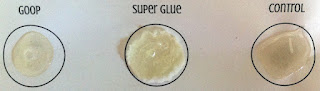
you can see that while the Goop and Control samples remained essentially transparent, the sample mixed with Super Glue yellowed slightly and curled/shriveled a bit (hard to see in the picture), particularly around the edges. this reaction was evident within the first few hours of the test, but worsened over the following day. another observation is that after fully 'curing', the AFF in the Goop and Control samples remained slightly flexible, whereas the Super Glue sample had turned extremely hard and brittle.
 this test confirmed my hypothesis that indeed a chemical reaction had occurred in my albie fly. as you can see, the albie fly is quite yellow, and this photo was taken 5 months after tying the fly. when tying, i had used quite a bit of Super Glue to stabilize and build up the pearl braid body, forming a belly. it's amazing that the Super Glue reacts with the AFF so significantly.
anyways, now i know, and now you know! here's where i get AFF.

a couple of months ago i noticed that a few of my albie flies where i had used AFF had yellowed. i wrote Casey about it and asked him if he had noticed any yellowing before. he had not, but suggested i perform a test. my suspicion was that the AFF had interacted with another material that i used. so, i decided to see if there was any reaction with two adhesives that i use, Goop (Craft version) and Super Glue's Future Glue.
this first picture is on day 1 of the test. you can see that once applied, AFF is essentially clear. if you look hard enough, unlike with the Super Glue sample, you can see the droplet of Goop i placed in the center, and how it did not mix with the AFF.

this second picture was taken after one month. the samples were placed indoors, but near a window to absorb sunlight during the daylight hours.

you can see that while the Goop and Control samples remained essentially transparent, the sample mixed with Super Glue yellowed slightly and curled/shriveled a bit (hard to see in the picture), particularly around the edges. this reaction was evident within the first few hours of the test, but worsened over the following day. another observation is that after fully 'curing', the AFF in the Goop and Control samples remained slightly flexible, whereas the Super Glue sample had turned extremely hard and brittle.

anyways, now i know, and now you know! here's where i get AFF.
Thursday, February 23, 2012
Eye For An Eye
a few years ago, while trying to find a substitute for E-Z Shape Sparkle Body, i read on an online forum that craft fabric paint is essentially the same thing, but at a huge discount. so i went to the local Michael's and literally bought out their whole entire supply of Scribbles 3D Paint in the Crystal Gel Transparent Sparkle color. i also bought a bunch of other colors, including one that is glow in the dark.
so, after reading Casey Smartt's post on fabric paint eyes, i thought i would give it a go myself. the eyes aren't perfect, but i think i'm slowing getting the technique down. it's amazing how little paint you have to use to make sure you have the right sized eye.
 what's nice about fabric paint eyes is that they are slightly flexible and slightly rubbery in texture. once they are dry, you can squeeze them 'a bit' and they return back to the original shape. also, since they are flexible, it's easier to glue them onto thread heads, since they essentially conform to the shape of the head.
anyways, i have to say that staring at all these eyes gives me the heebie jeebies. anyone else out there have trypophobia? don't know what that is? it's the fear of clustered holes. google it, but it's not for the faint of heart. i'm starting to get itchy and squirmy just thinking about it.

so, after reading Casey Smartt's post on fabric paint eyes, i thought i would give it a go myself. the eyes aren't perfect, but i think i'm slowing getting the technique down. it's amazing how little paint you have to use to make sure you have the right sized eye.

anyways, i have to say that staring at all these eyes gives me the heebie jeebies. anyone else out there have trypophobia? don't know what that is? it's the fear of clustered holes. google it, but it's not for the faint of heart. i'm starting to get itchy and squirmy just thinking about it.

Thursday, February 16, 2012
The Soundings of Silence (Part 2)
as we all know, Google has really made some terrific advances to its Google Maps and Google Earth products. what is amazing is that Google has allowed developers and others to build geocoded map layers that can overlay precisely on top of their products.
in my last post, i mentioned the downside to using the NOAA's paper charts or online chart viewer when prospecting for inshore fishing spots. what i like to do is overlay the NOAA charts onto Google Maps or Google Earth.
here is how to overlay the NOAA raster navigational chart (RNC) on top of Google Maps:
 1. go to the NOAA's interactive RNC catalog, and select the area you want to fish.
2. on the right, you will be able to choose if you want to download the RNC file, buy a paper map, or view the chart online. download the RNC file to your computer.
 3. go and download the beta version of Maptiler, which is a graphical application for online map publishing. Maptiler allows you to take the downloaded RNC files and create an overlay for Google Maps.
4. open Maptiler, and select 'Google Maps compatible'. hit 'Continue'.
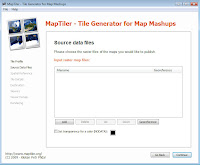
5. click 'Add', then find and select the .KAP file you downloaded from the NOAA.
6. hit 'Continue'.
7. At the screen that says 'Spatial reference system (SRS)', just skip by clicking 'Continue'.
8. again, skip the screen that says 'Details about the tile pyramid' by clicking 'Continue'.

9. choose the 'Result directory' on your computer. this is where the necessary files will be created.
10. hit 'Continue'.
 11. choose which viewers should be generated. i click both 'Google Maps' and 'OpenLayers'.
12. hit 'Continue'.
 13. you can title the map file anything you want.
14. since the development of this Maptiler application, the Google Maps API key is no longer 'optional'. you need to get a Google Maps API v3 here. once you get your API code, enter it in this screen.
15. hit 'Continue'.
16. on the last screen, 'Tile Rendering', hit 'Render' at the bottom right.
17. once the application has finished, find your new created files, and double click on the googlemaps.html file. this will open up your NOAA map on top of Google Maps! from here you can search for all the optimal places you want to fish. what i like to do is create a PDF of the new map, make some notes on top of it in Adobe Acrobat, and then upload it to my iPhone so i can access it on the water. if you are worried about using your iPhone on the water, you can just print out the new map and now you have a printed NOAA chart for free! for FRREEEEE!
my next goal is to somehow get the generated files and access them on my iPhone so i can have all the soundings on my mobile Google Maps. essentially that would create a duplicate GPS device, again...for free! for FRREEEEE!
also, if you want to keep track of all your waypoints and GPS tracks on Google Maps, you can convert your .GPX files to .KML files using the website GPS Visualizer. once you have your .KML file, you can upload it to Google Maps or import it into Google Earth.
in part 3, i will go through the steps of creating an NOAA overlay using their electronic navigational charts (ENC) for Google Earth. this process is a bit more complicated, but gives you greater flexibility as to the data you want to access.
in my last post, i mentioned the downside to using the NOAA's paper charts or online chart viewer when prospecting for inshore fishing spots. what i like to do is overlay the NOAA charts onto Google Maps or Google Earth.
here is how to overlay the NOAA raster navigational chart (RNC) on top of Google Maps:

2. on the right, you will be able to choose if you want to download the RNC file, buy a paper map, or view the chart online. download the RNC file to your computer.

4. open Maptiler, and select 'Google Maps compatible'. hit 'Continue'.

5. click 'Add', then find and select the .KAP file you downloaded from the NOAA.
6. hit 'Continue'.
7. At the screen that says 'Spatial reference system (SRS)', just skip by clicking 'Continue'.
8. again, skip the screen that says 'Details about the tile pyramid' by clicking 'Continue'.

9. choose the 'Result directory' on your computer. this is where the necessary files will be created.
10. hit 'Continue'.

12. hit 'Continue'.

14. since the development of this Maptiler application, the Google Maps API key is no longer 'optional'. you need to get a Google Maps API v3 here. once you get your API code, enter it in this screen.
15. hit 'Continue'.
16. on the last screen, 'Tile Rendering', hit 'Render' at the bottom right.
17. once the application has finished, find your new created files, and double click on the googlemaps.html file. this will open up your NOAA map on top of Google Maps! from here you can search for all the optimal places you want to fish. what i like to do is create a PDF of the new map, make some notes on top of it in Adobe Acrobat, and then upload it to my iPhone so i can access it on the water. if you are worried about using your iPhone on the water, you can just print out the new map and now you have a printed NOAA chart for free! for FRREEEEE!
my next goal is to somehow get the generated files and access them on my iPhone so i can have all the soundings on my mobile Google Maps. essentially that would create a duplicate GPS device, again...for free! for FRREEEEE!
also, if you want to keep track of all your waypoints and GPS tracks on Google Maps, you can convert your .GPX files to .KML files using the website GPS Visualizer. once you have your .KML file, you can upload it to Google Maps or import it into Google Earth.
in part 3, i will go through the steps of creating an NOAA overlay using their electronic navigational charts (ENC) for Google Earth. this process is a bit more complicated, but gives you greater flexibility as to the data you want to access.
The Soundings of Silence (Part 1)
ugh. seems like the mild winter has everyone and their mother catching fish. i haven't even made an attempt since returning home from Dallas. there is a stocked river not 20 minutes from my home, yet i don't even think about going. why?
1) i don't want to fish with 2 other anglers at each hole
2) with my first 6 month old son at home, it gets harder and harder to leave.
for those of you with kids, you'll understand...this time in his life is just so fun. he is changing and developing every hour, and i just don't want to miss anything.
so that's the reason for my online silence. but just because i'm not fishing, doesn't mean i'm not constantly thinking about it. i'm dreaming of early May when i can paddle some of the northeast flats and sight fish for stripers. but if you're anything like me, you study up before heading out. here are some relevant, oldie but goodie articles.
Shallow Water Stripers (Nick Curcione)
Stripers on the Flats (Tom Richardson)
Fly Fishing Eastern Long Island and the Montauk Point Area (Amanda Switzer)
Shinnecock East: Disneyland for Fishermen (Michael Wright)
The Skinny on Long Island Flats Fishing (Angelo Peluso)
now that i've covered the 'how', i use maps to help me figure out the 'where'. as you know, the one essential tool for fishing the salt is a GPS device. i have a handheld Garmin for when i'm out on the yak, but use the Navionics app on my iPhone as well. in my opinion, both screen sizes are way too small in general, but particularly when trying to cover lots of water in order to find the optimal spots. so i try to pick out my spots before even getting to the water.
most of you know that the NOAA provides nautical maps with soundings (depths). the NOAA offers maps in 5 ways:
1) paper charts for purchase (i'm too cheap for this option)
2) print-on-demand charts for purchase (i'm too cheap for this option, too)
3) online chart viewers (limited viewing area, too cumbersome to use)
4) downloadable raster (image-based) charts
5) downloadable electronic (vector-based) charts
in part 2 i will cover how i use the NOAA's raster charts and electronic charts in combination with Google Maps and Google Earth.
1) i don't want to fish with 2 other anglers at each hole
2) with my first 6 month old son at home, it gets harder and harder to leave.
for those of you with kids, you'll understand...this time in his life is just so fun. he is changing and developing every hour, and i just don't want to miss anything.
so that's the reason for my online silence. but just because i'm not fishing, doesn't mean i'm not constantly thinking about it. i'm dreaming of early May when i can paddle some of the northeast flats and sight fish for stripers. but if you're anything like me, you study up before heading out. here are some relevant, oldie but goodie articles.
Stripers on the Flats (Tom Richardson)
Connecticut's First Stripers (Frank Daignault)
Season Opener (Alan Caolo)
Northeast Flats Primer (Alan Caolo) Fly Fishing Eastern Long Island and the Montauk Point Area (Amanda Switzer)
Shinnecock East: Disneyland for Fishermen (Michael Wright)
The Skinny on Long Island Flats Fishing (Angelo Peluso)
now that i've covered the 'how', i use maps to help me figure out the 'where'. as you know, the one essential tool for fishing the salt is a GPS device. i have a handheld Garmin for when i'm out on the yak, but use the Navionics app on my iPhone as well. in my opinion, both screen sizes are way too small in general, but particularly when trying to cover lots of water in order to find the optimal spots. so i try to pick out my spots before even getting to the water.
most of you know that the NOAA provides nautical maps with soundings (depths). the NOAA offers maps in 5 ways:
1) paper charts for purchase (i'm too cheap for this option)
2) print-on-demand charts for purchase (i'm too cheap for this option, too)
3) online chart viewers (limited viewing area, too cumbersome to use)
4) downloadable raster (image-based) charts
5) downloadable electronic (vector-based) charts
in part 2 i will cover how i use the NOAA's raster charts and electronic charts in combination with Google Maps and Google Earth.
Wednesday, January 25, 2012
Feeling Crabby
everytime i get my copy of Fly Fishing in Saltwater in the mail, i savor it like it was my last meal alive. i wait until the end of the day, then devour it cover to cover. i've added to this bimonthly ritual by reading Eastern Fly Fishing. so far, these two magazines are the only print magazines i read, not only because they address the exact type of fishing i'm interested in, but the quality of their content remains consistently awesome. in the November/December 2011 issue of EFF, they profiled Colby Hane's Corona Crab fly.
here's my feeble attempt at tying it. i substituted the grizzly hackle
collar with one made out of mallard flank. i thought it looked cooler
and will perhaps have a bit more movement. the eyes were made using
Aleene's Fabric Fusion, a la Casey Smartt.
the weed guard was tied following EP's nifty technique below.
once i got into the groove of tying, i decided to tie a few more flies...
This River is Wild's Fly of the Trip. here i ended up using Lion Brand's Velvet Spun pink chenille for the legs. i didn't have the same color or size chenille as the recipe called for, but i think this works well. the fly is incredibly light, so i'll be using this for the shallower flats.
lastly, i tied the famous Avalon Crab permit fly using instructions from the Caddis Fly Shop and Erik Moncada. again, i made a couple of substitutions. i thought the recipe's lead eyes were much too heavy, so i downsized a bit and went with brass eyes. to reduce the weight further, i used plastic beads instead of metal beads for the rattle (two beige/one orange). i used large, 7mm beads to ensure a louder sound, as well as help the fly settle in the sand with some stability. the orange bead is in front to help simulate the egg sack. i tested this fly out in my bathtub and the sink rate is still pretty quick. however, the lighter beads causes the fly stand up almost vertically like a plastic worm on a jig head. there is tons of movement, and the crab settles in the defensive position.
 |
| Corona Crab |
the weed guard was tied following EP's nifty technique below.
once i got into the groove of tying, i decided to tie a few more flies...
 |
| Fly of the Trip |
 |
| Avalon Crab Variant |
Wednesday, January 11, 2012
Buff, Buff, Pass?
this economy sucks, right? everyone is feeling the pinch, especially me. so, when i wanted to purchase another Buff Headwear, i cringed at the retail price.
 i may sound like a wuss, but my lips are so sensitive. if they get
prolonged exposure to sun, i get cold sores. if there is even the
slightest breeze, my lips get wind chapped and i look like Clint
Eastwood in The Good, The Bad, and The Ugly after he has been forced to
walk in the blazing desert sun without water. if i'm out on a boat in
the LIS, chances are my lips will get chapped. if i get chapped lips, my wife complains (heh heh). so i wear my Buff every
time i go fishing.
i may sound like a wuss, but my lips are so sensitive. if they get
prolonged exposure to sun, i get cold sores. if there is even the
slightest breeze, my lips get wind chapped and i look like Clint
Eastwood in The Good, The Bad, and The Ugly after he has been forced to
walk in the blazing desert sun without water. if i'm out on a boat in
the LIS, chances are my lips will get chapped. if i get chapped lips, my wife complains (heh heh). so i wear my Buff every
time i go fishing.
i absolutely love my Buff UV Angler in the bonefish pattern, but $21-$23 is a bit more than i would like to spend right now.
so i decided to look into cheaper alternatives. it's amazing how many different companies are now selling Buff-like products. whether it's called a Buff, a tubular bandana, a tubudana, a wrap, or just a gaiter, there are tons of companies jumping on the bandwagon. Just to name a few...
Flying Fisherman - Sunbandit
ZanHeadgear - Motley Tube
Mental Gear - Headcase
Simms - Sungaiter
Patagonia - Printed Sun Mask
Columbia Sportswear - Freezer Neck Wrap
Ergodyne - Multi-band
Smotard
Aqua Design - SunGuard Tube
 i ended up buying two pieces on eBay after doing a search for "multi headwear". i purchased one from a wholesaler named Tans Club. it is plain white, and bought it for $0.70 including shipping. Let's call it "Tan's piece".
 the second piece i purchased was $7.00 including shipping, and it has a pattern on it with similar colors to my bonefish Buff. i purchased it from a Chinese vendor on eBay, and it came in Chinese packaging, so let's call it "Chinese piece".
so the question is...what's the difference between those and the branded Buff Headwear? is the real Buff worth the cost difference?
Sizing
since i do not have a scientific way of measuring the thickness of each piece, i can only qualitatively estimate the differences in thickness. the white Tan's piece felt slightly thinner than the Buff or the Chinese piece. it might have something to do with the additional design that is painted on (or whatever technique) the fabric. the thickness (or rather thinness) wasn't noticeable on my neck in any way.
the dimensions of each are the same. the Buff is listed at 20" long and 9.5" wide. the Tan's piece is listed at 20" long and has a 19" perimeter. the Chinese piece is 20.7" long and 9.5" wide.
Material
Tan's piece and the Chinese piece is made of 100% polyester microfiber. polyester is a great synthetic material that wicks away moisture and sweat. that's perfect for hot days bonefishing in the Caribbean, and also great for cold weather environments where you don't want your sweat to freeze and lower your body temperature. the Buff UV Angler is made of 100% polyester microfiber with Coolmax®. according to Buff, "Coolmax® is a more technical, four-channel fiber with advanced moisture wicking capabilities", and "and is a bit softer to the touch compared to basic microfiber".
Sun Protection
another great thing about polyester is that it protects against ultraviolet rays. that's where the UPF (ultraviolet protection factor) comes in. polyester alone has 30+ UPF which means that 1/30th of an ultraviolet ray is passing through the fabric. that's why they can claim that 95% of ultraviolet rays are blocked. however, there are many variables that affect the UPF rating, such as (but not limited to) color, paint, shine, moisture, and stretch. there is a variety of finishing agents, like SunGuard detergent, that can augment ultraviolet protection, but i'm not aware of any finishing agent used on any of the above pieces.
Performance
it is hard to tell the difference in how effective each piece was in blocking ultraviolet rays. my only data point is that my wife said i looked more tan after wearing the Tan's piece (pun not intended). that would make some sense, because the slightly darker colors of the Chinese piece and the Buff would absorb more UV light.
i also could not tell any difference in each's ability to wick away moisture. however, i tested each piece on a different day, which had different outside temperatures and wind speeds.
Conclusion
so, with the sizing, sun protection, and performance being essentially the same, what is my conclusion? is Buff worth the extra cost? my answer is definitively, yes! why?
1. Buff provides many more patterns to choose from, and they appeal to the style-conscious angler.
2. the Coolmax® texture does actually make a difference. it is slightly softer then the other two pieces, and after pulling the pieces up and down my face all day, the extra softness is noticeably gentler on my skin (heh heh)
3. last but not least, each Buff contains Polygiene®, which utilizes silver ions to prevent the growth of odor-causing bacteria. fish stink combined with sweat does not create a pleasant odor, especially when this thing is worn right next to your nose. this feature alone is worth the price of admission.
so ultimately, all the added technology and features of the Buff do make it worth the price. however, if you are on a budget like me, sometimes you have to make sacrifices and go with the lower quality product.
since there are many other brand name products out there with legitimate fabric technology, if my budget permits, i will try to write a second part to this review with additional competitors, updated comparisons, and longer-term testing.
also, since it is freakin' freezing outside, i want to get my hands on a Polar Buff and compare it to some fleece neck gaiters.
8/25/12 update the Tan's piece is not worth the low price. after about 10 washes, the piece is full of fabric pills, and almost feels rubbery, losing most of its softness. as for the Buff and Chinese pieces, they are still going strong.
 i may sound like a wuss, but my lips are so sensitive. if they get
prolonged exposure to sun, i get cold sores. if there is even the
slightest breeze, my lips get wind chapped and i look like Clint
Eastwood in The Good, The Bad, and The Ugly after he has been forced to
walk in the blazing desert sun without water. if i'm out on a boat in
the LIS, chances are my lips will get chapped. if i get chapped lips, my wife complains (heh heh). so i wear my Buff every
time i go fishing.
i may sound like a wuss, but my lips are so sensitive. if they get
prolonged exposure to sun, i get cold sores. if there is even the
slightest breeze, my lips get wind chapped and i look like Clint
Eastwood in The Good, The Bad, and The Ugly after he has been forced to
walk in the blazing desert sun without water. if i'm out on a boat in
the LIS, chances are my lips will get chapped. if i get chapped lips, my wife complains (heh heh). so i wear my Buff every
time i go fishing.i absolutely love my Buff UV Angler in the bonefish pattern, but $21-$23 is a bit more than i would like to spend right now.
so i decided to look into cheaper alternatives. it's amazing how many different companies are now selling Buff-like products. whether it's called a Buff, a tubular bandana, a tubudana, a wrap, or just a gaiter, there are tons of companies jumping on the bandwagon. Just to name a few...
Flying Fisherman - Sunbandit
ZanHeadgear - Motley Tube
Mental Gear - Headcase
Simms - Sungaiter
Patagonia - Printed Sun Mask
Columbia Sportswear - Freezer Neck Wrap
Ergodyne - Multi-band
Smotard
Aqua Design - SunGuard Tube
 i ended up buying two pieces on eBay after doing a search for "multi headwear". i purchased one from a wholesaler named Tans Club. it is plain white, and bought it for $0.70 including shipping. Let's call it "Tan's piece".
 the second piece i purchased was $7.00 including shipping, and it has a pattern on it with similar colors to my bonefish Buff. i purchased it from a Chinese vendor on eBay, and it came in Chinese packaging, so let's call it "Chinese piece".
so the question is...what's the difference between those and the branded Buff Headwear? is the real Buff worth the cost difference?
Sizing
since i do not have a scientific way of measuring the thickness of each piece, i can only qualitatively estimate the differences in thickness. the white Tan's piece felt slightly thinner than the Buff or the Chinese piece. it might have something to do with the additional design that is painted on (or whatever technique) the fabric. the thickness (or rather thinness) wasn't noticeable on my neck in any way.
the dimensions of each are the same. the Buff is listed at 20" long and 9.5" wide. the Tan's piece is listed at 20" long and has a 19" perimeter. the Chinese piece is 20.7" long and 9.5" wide.
Material
Tan's piece and the Chinese piece is made of 100% polyester microfiber. polyester is a great synthetic material that wicks away moisture and sweat. that's perfect for hot days bonefishing in the Caribbean, and also great for cold weather environments where you don't want your sweat to freeze and lower your body temperature. the Buff UV Angler is made of 100% polyester microfiber with Coolmax®. according to Buff, "Coolmax® is a more technical, four-channel fiber with advanced moisture wicking capabilities", and "and is a bit softer to the touch compared to basic microfiber".
Sun Protection
another great thing about polyester is that it protects against ultraviolet rays. that's where the UPF (ultraviolet protection factor) comes in. polyester alone has 30+ UPF which means that 1/30th of an ultraviolet ray is passing through the fabric. that's why they can claim that 95% of ultraviolet rays are blocked. however, there are many variables that affect the UPF rating, such as (but not limited to) color, paint, shine, moisture, and stretch. there is a variety of finishing agents, like SunGuard detergent, that can augment ultraviolet protection, but i'm not aware of any finishing agent used on any of the above pieces.
Performance
it is hard to tell the difference in how effective each piece was in blocking ultraviolet rays. my only data point is that my wife said i looked more tan after wearing the Tan's piece (pun not intended). that would make some sense, because the slightly darker colors of the Chinese piece and the Buff would absorb more UV light.
i also could not tell any difference in each's ability to wick away moisture. however, i tested each piece on a different day, which had different outside temperatures and wind speeds.
Conclusion
so, with the sizing, sun protection, and performance being essentially the same, what is my conclusion? is Buff worth the extra cost? my answer is definitively, yes! why?
1. Buff provides many more patterns to choose from, and they appeal to the style-conscious angler.
2. the Coolmax® texture does actually make a difference. it is slightly softer then the other two pieces, and after pulling the pieces up and down my face all day, the extra softness is noticeably gentler on my skin (heh heh)
3. last but not least, each Buff contains Polygiene®, which utilizes silver ions to prevent the growth of odor-causing bacteria. fish stink combined with sweat does not create a pleasant odor, especially when this thing is worn right next to your nose. this feature alone is worth the price of admission.
so ultimately, all the added technology and features of the Buff do make it worth the price. however, if you are on a budget like me, sometimes you have to make sacrifices and go with the lower quality product.
since there are many other brand name products out there with legitimate fabric technology, if my budget permits, i will try to write a second part to this review with additional competitors, updated comparisons, and longer-term testing.
also, since it is freakin' freezing outside, i want to get my hands on a Polar Buff and compare it to some fleece neck gaiters.
8/25/12 update the Tan's piece is not worth the low price. after about 10 washes, the piece is full of fabric pills, and almost feels rubbery, losing most of its softness. as for the Buff and Chinese pieces, they are still going strong.
Sunday, January 1, 2012
Bird on a Wire
i know this blog is supposed to be about fishing, and here i am, writing another post about birds. all i'm saying is that birds can be pretty ominous and gross. i guess they like chinese food and are waiting in line at Panda Express.
Friday, December 30, 2011
A First Before the First
i finally got to go out and fish an area that i heard many good things about. the temperature was in the mid-60s, and by the time i arrived at 11 AM, there were a bunch of guys already there, some with light spinning rods, and some with fly rods. everyone i met was incredibly nice and helpful, freely offering me tips and useful information. it's pretty amazing how gracious and affable people are when you leave the northeast.
most of those people were there to catch the recently stocked, 8-10" rainbow trout or the plentiful blue catfish. i, other the other hand, was on a different mission. i was after carp. common, mirror, buffalo, whatever.
i left the crowds of people fishing the same holes and ventured further away, finally getting to an isolated area that contained a large, deep pool, and a couple of close-by sand bars. i climbed the steep hill nearby for a better look, and i could spot some bass and several rainbows. there were also two pods of large, slow moving carp, altogether about 10-12 fish. there was one that might have been 20 lbs, but hard to tell at a distance. i realized immediately that only a few of them moved as if they were feeding. good thing i watched Mr. P's video recently.
anyways, i snuck up on the fish, cast to them in 3 feet of crystal clear water, and i'm proud to say that i caught my first buffalo carp on a fly.

i used a 5wt rod, and the fly i used was Roughfisher's Carp Crack that I tied in my custom rust color dubbing.


most of those people were there to catch the recently stocked, 8-10" rainbow trout or the plentiful blue catfish. i, other the other hand, was on a different mission. i was after carp. common, mirror, buffalo, whatever.
i left the crowds of people fishing the same holes and ventured further away, finally getting to an isolated area that contained a large, deep pool, and a couple of close-by sand bars. i climbed the steep hill nearby for a better look, and i could spot some bass and several rainbows. there were also two pods of large, slow moving carp, altogether about 10-12 fish. there was one that might have been 20 lbs, but hard to tell at a distance. i realized immediately that only a few of them moved as if they were feeding. good thing i watched Mr. P's video recently.
anyways, i snuck up on the fish, cast to them in 3 feet of crystal clear water, and i'm proud to say that i caught my first buffalo carp on a fly.

i used a 5wt rod, and the fly i used was Roughfisher's Carp Crack that I tied in my custom rust color dubbing.


Sunday, December 25, 2011
Close Encounter of the Bird Kind
okay, so i stole out to a couple of local ponds in the area to do some Christmas fishing. our family decided we were going to do the white elephant Christmas gift exchange, and i had about 1.5 hours to kill beforehand. i had read that these ponds were good places for carp or LMB, but as i came to the second pond, i have to admit, i freaked out a bit. as i arrived, a bunch of different birds were going crazy, flying around, chirping up a storm. it actually reminded me of how bait scatters when stripers or blues are around. then i saw it... an enormous hawk. it was stalking these birds and they were signalling each other.
 then the hawk swooped down and i got a good look as to how big it was. i swear, the wingspan must have been at least 6 feet. i then thought, given the size, it must be an owl or something. but as i got a good look...it was a hawk. the thing was big enough that i thought that, no problem, this thing could take me out easily. i got freaked out and blew out of there. i know it wouldn't harm me, but holy cow, that thing is a predator.

Subscribe to:
Posts (Atom)